Tuesday, October 14, 2014

HONOR AMONG THIEVES Sneak Peek: Meet Bluebell!

My new Regency romance series, The Honorables, kicks off in less than two weeks with the release of HONOR AMONG THIEVES on October 27. I can't believe it's already almost here! I'm so excited to share this novel with you. This story has been kicking around in the back of my mind for years, waiting for all the pieces to fall together. They finally did, and I'm thrilled with the result. I hope you will be, too.

While we're waiting for October 27 to get here, I thought I'd introduce you to one of the characters you'll encounter in this tale that carries us to the dark underbelly of Regency London. HAT's heroine, Lorna, joins a gang of resurrectionists, body snatchers who plundered graves and sold corpses to surgeon-anatomists for dissection. One of the members of the group is Bluebell, a bloodhound who sniffs out fresh graves. And though she has a grim job, Bluebell aspires to a cushier life. Click through for an excerpt, and a chance to win an advance e-copy of HONOR AMONG THIEVES:

Tuesday, June 10, 2014

Announcing The Honorables!

So, after a long while of people asking me WHEN is my next book coming out, I finally have an answer for you: this fall!

I've just signed on with Crimson Romance again to release my new Regency Romance series, called The Honorables. The series will consist of five titles, three full-length novels and two novellas. Book one launches in October, with a new title coming out every three months. It's an ambitious schedule and I'm a little daunted, but I know I can do it! I've been thinking about this series for years, and I'm so happy to have the chance to bring it to you.

Who Are The Honorables?

Back in the day, groups of friends often named themselves and held club meetings. JRR Tolkien and CS Lewis both belonged to a small literary discussion group called The Inklings, for example. In current historical romance, you'll find The Survivors' Club, Mary Balogh's group of Napoleonic War veteran heroes, and Celeste Bradeley's Liar's Club, a group of Regency-era spies.

In a similar vein, I have formed The Honorables, a group of five friends who belong to noble families, but who will never inherit the title. The men meet at Oxford University, where they form their little society and bond over pints at the local pub. The friendship carries over to their adulthoods in London, and plays an integral part in each man's story.

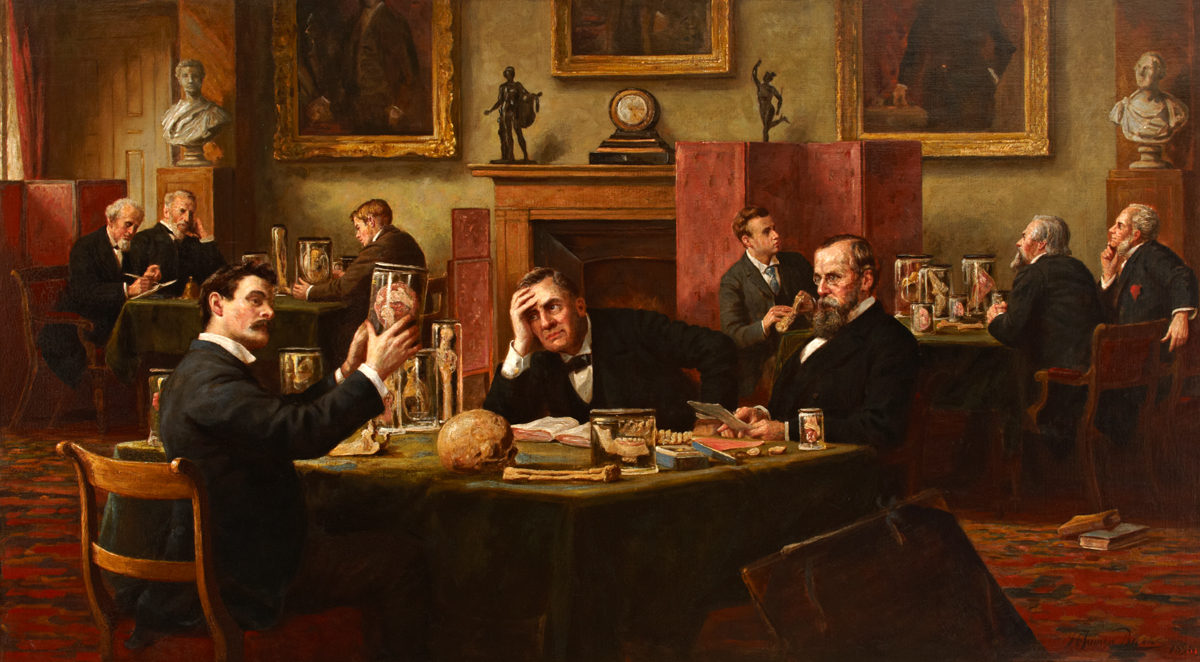
The first member of the group you will meet is Brandon Dewhurst, the youngest of Viscount Marcel's five sons. He's an anatomist-surgeon, working on the frontier of medical knowledge in Regency London. He has a passion for his work, but knows the macabre nature of his calling and younger son status make him all-too-resistible to the young ladies of the haut ton's infamous Marriage Mart. Everything changes when he meets Lorna Robbins, a lady who doesn't mind his work, and who seems to be carrying a dark secret of her own.

Don't lie. I know you wish you were that brain in a jar. HOT!!!


What does 'The Honorables' mean?

History lesson time! During the Regency (and beyond, but I speak only about the time period in which I write), men who carried titles were referred to as Peers of the Realm. These are your dukes and marquesses and earls, etc. The Lords. The heirs of these titled noblemen might carry what is called a Courtesy Title. For example, the son of Joe Johnson, Earl of Chicago might be known as Viscount Indianapolis. It all had to do with how many titles the family patriarch possessed. In this example, the father owns both the earldom and viscountcy, but since he is only called by his highest title (Earl), his eldest son gets use of the next-highest title he owns (Viscount) until he dies. The heir's title, Lord Indianapolis, is a courtesy only, carrying no real legal weight. In the eyes of the law, he is a commoner. He does not become a peer in his own right until his father dies, making him the new earl.

The younger son(s) of the Earl of Chicago does not receive a courtesy title, no matter how many additional viscountcies or baronies might be attached to his father's name. He is simply referred to as Mr. Johnson, although his full legal title, in recognition of his family's status, is The Honorable Mister Johnson. Your boyfriend Mr. Darcy, the untitled grandson of an earl (his father was a younger son) carries the moniker The Honorable Mister Fitzwilliam Darcy.

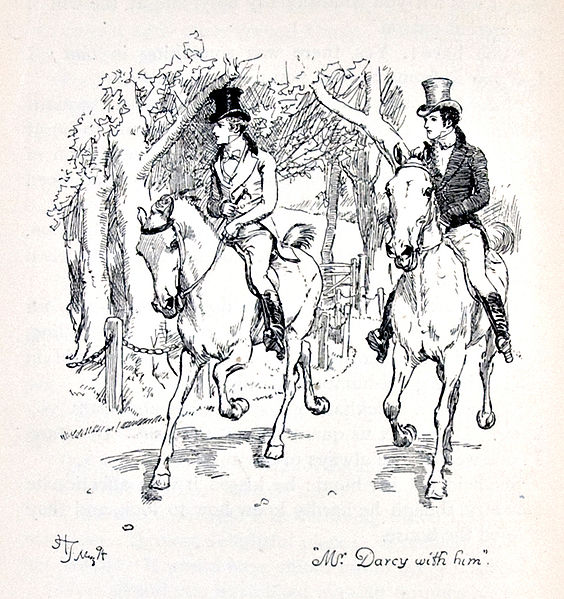
The Honorable Misters Bingley and Darcy. When's the last time you read a Regency romance novel featuring a Mister?
That's what I thought.


And thus the name of both the group of friends, and the series. The Honorables is about men who aren't your typical Regency heroes. None of them are peers. There are no dukes, no earls, no viscounts. Each man belongs to a noble family led by a titled peer, but these are the younger sons or grandsons, the guys typically overlooked in contemporary Regency romance. Some of them, such as The Honorable Mr. Brandon Dewhurst in book one, have a profession, rendering them bad matches on the great Marriage Mart of the haut ton. Others, like book three's Lord Sheridan Zouche (courtesy title only; his legal name is The Honorable Mister Sheridan Zouche), are happy dwelling on the edges of the ballrooms and parlors, enjoying their allowances and lack of responsibility.

There are no grand estates to be inherited, no massive fortunes at stake, no titles to pass along. For this series, I have dug deeper into the Regency's rich, fascinating history to bring you stories you won't find elsewhere. Together, we'll explore the criminal underworld of body snatching, the East India Company's massive trade empire, a political campaign gone haywire, and so much more. Along the way, you'll meet the heroines who tame the hearts of these fiercely independent gentlemen. They are women like you, struggling with financial difficulties, family problems, and feelings of not fitting in. When they find their men, though... watch out. The sparks are going to fly, and the temperature is going to rise as wits and passion collide on the way to true love.

I hope you'll join me for this exciting journey.

Monday, May 5, 2014

Retreat!

Right this second, I'm sitting in the middle of a gorgeous green lawn, reclining in a lounge chair, with my laptop in my lap and my eyeballs closed. A refreshing breeze is blowing across my face and arms, while the sun's warmth keeps me from getting too cold. I'm on retreat. A writer's retreat. And it's heaven.

I just opened my eyes, but I can't make out the screen clearly on account of my sun-blinded eyeballs (turning one's face up to the sun will do that, I suppose, even with your lids clamped down), so I'll keep writing without the assistance of visual input for a while longer.

For the last few months, I've been dealing with my usual winter blahs. Spring arrived, but the inspiration didn't come with it. I haven't written as much or as well as I'd like. I have allowed myself to get caught up in everything else that needs my attention: children; spouse; laundry; house; cat. Meanwhile, the manuscript doesn't impose. It doesn't insist I work on it. It just sits on my hard drive, patiently waiting for me, accepting whatever bits of time I give it.

The trouble is, if you let it, a manuscript will do nothing but wait. In my experience, manuscripts EXCEL at waiting. They might even major in it at college. While they sit there, waiting all professional-like, everything else in a writer's life continues to demand her notice. Loudly. It's so easy to lose the stride, the fire.

Seriously, I can't see. What is this even?


Enter the writing retreat.

One of my very best friends in all the world knew I was struggling, and she generously invited me to come to her home to work. She and her husband (another of my very favorites) have treated me like an honored guest, their Author In Residence, while I've been here. They've seen to my every need while I have taken over a whole portion of their house, spreading my research materials, computer, and personal belongings all over the place. They've fed me beautiful meals and refused to allow me to do the dishes. They've told me my only responsibility here is to get inspired and WRITE.

And boy howdy, I have written.

It's amazing what miracles a change of scenery can do, what wonders can be wrought by a temporary reprieve from responsibility. With nothing else to focus on, my brain has been working in overdrive, churning out more words in the last four days than I've written in the whole last month. Right this minute, writing isn't something that's getting in the way of all the other stuff I have to do for my family and home. It's a pleasure, a wonderful, beautiful pleasure. THIS is why high school and college students can churn out poem after poem. When you've got nothing to do but think about the story... you think about the story. And you write it. And maybe also a blog post for the poor, neglected blog.

Calling an event like this a retreat is apt. What is a retreat, but an occasion to pull back and regroup? When faced with an overwhelming situation, a retreat allows a writer (or an army) to strategically refocus the effort where it's most needed.

Tomorrow is my last day of retreat. Wednesday, I return to my life and all the business that is going to try to pull me away from my writing. I hope to carry with me the feeling of my retreat, of being able to disengage from everything around me for a short time to focus on the work. To remember why it is I love writing so freaking much.

Friday, February 28, 2014

Daffodowndilly

Daffodowndilly
by: A.A. Milne
She wore her yellow sun-bonnet,
She wore her greenest gown;
She turned to the south wind
And curtsied up and down.
She turned to the sunlight
And shook her yellow head,
And whispered to her neighbour:
'Winter is dead.' 


Little darling, it's been a long cold lonely winter, hasn't it?

Even here in the South, we've had more than our fair share of gray skies, sub-arctic temperatures, and rain falling to earth in an unnatural, solid state. In a region where any amount of snowfall is a rare treat, this winter has taught us to dread the words "frozen precipitation" This has been the year of the Polar Vortex, a climate event that sounds like it was conceived in the volcano lair of a Bond villain.

The entire North American continent is suffering from the winter blahs, but this week I spotted the light at the end of the tunnel: My daffodils bloomed.

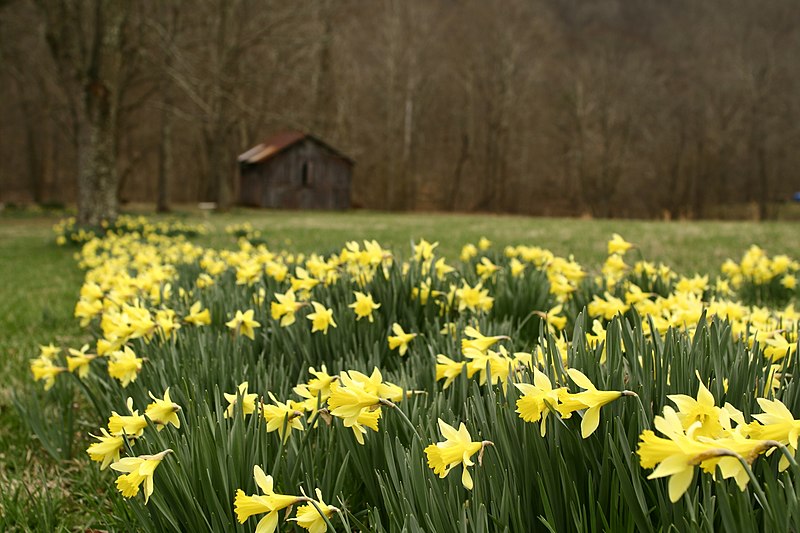
These aren't my actual flowers. Or my actual barn. These are paid re-enactors.


I'm usually not much for spring. Typically, we get a week or two of pleasant spring temps, accompanied by bucketfuls of pollen in the air, and then we plow right on into summer. Spring is a quick pit stop on the way to the main event--heat and humidity.

But this year... man, I'm really digging the idea of spring. When I saw the daffodils in my front yard burst into their glorious yellow blooms, my heart opened right along with them. Yesterday, we woke up to yet another frost on the ground, and I feared the flowers were done for. But this morning they're nodding in the breeze, defying the lingering cold and forcing bright color onto our muted landscape of brown and gray.

When I studied abroad in France during college, I took an oral presentation course. One of our assignments was to speak about a festival in our hometowns. I'll never forget the speech given by a Swedish student. She told us about her town's annual spring festival, how everyone got together for days of music and revelry to celebrate having made it through the winter. In my area, we celebrate particular crops, like watermelons, peaches, cucumbers, peanuts... whatever a given little town produces lots of. The idea of celebrating basic survival touches on something primal and intrinsic. And after the brutal season we've endured, I think we're all due a little fun.

Spring reaches past our modern, civilized exterior to grab us right by our pagan roots. To this day, all of our spring holidays are about fertility, sex, new life, renewal. The ground thaws to accept seeds. Plants engage in passive sexual reproduction and douse our cars and our respiratory tracts with their sperm. Spring fever hits humans and other animals, granting us increases in energy and sexual appetites. The entire hemisphere (Sorry, Antipodeans, you already had your turn.) pulses with vigor and desire.

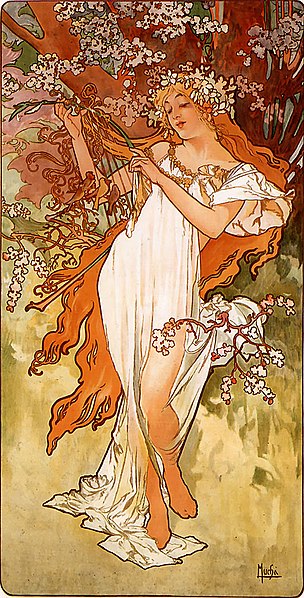
It's little wonder our ancestors welcomed spring with music and dancing and wine and fertility rites and feasting and little fuzzy bunnies and chicks. Flowers and soil and green and youth and breasts and sap and cherubs and the sun. The sun. That glorious giver of life and light. It came back. And we honor it, we thank it for keeping its promise. Every civilization throughout history has worshiped the sun. How can we not?

The sentiment... I get it.

I know winter isn't quite over for a lot of you. There's still a stretch of miserable cold and dreary, leaden skies in the coming weeks, but we're almost there. I promise. Daffodils don't lie. Hang in there. The ice is slowly melting.


Friday, February 14, 2014

Be Mine

Today is February 14, Valentine's Day, a holiday with the power to reduce the best of us to quivering heaps of adolescent uncertainty: Is it too soon to get him a gift? Will she think I lack imagination if I buy her chocolates? Will the comically oversized box earn back originality points? What if he doesn't like teddy bears? Haven't we been together too long for this nonsense? Is it weird to say "Happy Valentine's Day" to my boss, or is it weirder not to say anything?

Someone you encounter today will tell you Valentine's Day is a made-up holiday pushed by a secret coalition of greeting card companies, candy cabals, and floral cartels trying to boost profits in the post-Christmas slump. Those people are wrong.


Maybe. The above could only have come from a soulless
Faustian fraternity working in concert with the minions of Hell.


Here are some fun facts about the history of Valentine's Day you can use to put the naysayers in their place, and to dazzle your friends and lovers.

You might know that Valentine's Day originated as a Catholic feast commemorating St. Valentine, but did you know there is more than one St. Valentine honored by the day? Valentine of Terni was a second century bishop martyred during the Roman persecution of Christians. When he was jailed for preaching his faith, he reputedly healed his jailer's daughter of blindness, thus earning a few new converts and a date with clubs, stones, and the executioner's axe. Valentine of Rome hails from the fifth century. He was also persecuted, imprisoned, tortured, and executed. Romance! Legend has it that Mr. Of Rome performed secret marriage ceremonies for Roman soldiers, who were forbidden to marry. His flower-adorned skull is a relic on display in the Basilica of Santa Maria in Cosmedin.

Your move, Hallmark.

The feast of St. Valentine was not originally fixed to the fourteenth day of February. Even today, the Eastern Orthodox church honors the Saints Valentine in July, on the sixth for Valentine of Rome, and on the thirtieth for Valentine of Terni.

Valentine's Day was first connected to romantic love by Geoffrey Chaucer in the high middle ages. To commemorate the engagement of King Richard II of England to Anne of Bohemia, he penned "Parlement of Foules," which begins:

For this was on seynt Volantynys day
Whan euery bryd comyth there to chese his make.

Mid-February isn't really sexy time for most species of birds in England, so this poem also provides a clue that Valentine's Day wasn't always observed on 14 February, but sometime later in the spring. Also, we know the engagement was made official in a treaty signed May 2, 1381. Aww, political marriages. Romance!

Over the next many centuries, Valentine's Day really hit its stride. It was a big hit with followers of the courtly love traditions. Valentine love poems and letters dating back to the 1400's have survived to tell the tale. Donne and Shakespeare both wrote about Valentine's Day ( in "An Epithalamion, Or Mariage Song, On The Lady Elizabeth, And Count Palatine Being Married On St. Valentines Day" and Hamlet, respectively).

The giving of flowers and chocolates on Valentine's Day are folk traditions from the UK which commemorate the early advent of spring. In some places, sweets and gifts were left for children, while other communities latched onto it as a celebration of romantic love.

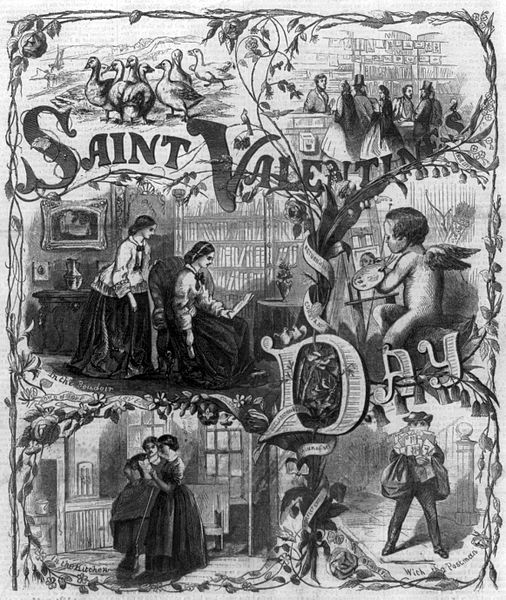
The ducks are an interesting artistic choice.
Charges of mass-produced sentiment are frequently leveled at manufactures of greeting cards, but you can't blame American Greetings for spreading a bad idea. In 1797, The Young Man's Valentine Writer was published in Britain. Its pages were filled with verses a young swain could copy out to send his beloved. A few commercially produced cards embellished with sketches and poems, called "mechanical Valentines," were available in the late 1700's, although they were not manufactured on a large scale until the Victorian era. By the turn of the nineteenth century, young lovers of both sexes were sending an astonishing number of poems and letters to one another through the post, using the holiday as an excuse to toss propriety to the wind.

A couple years back, one of my favorite blogs, Two Nerdy History Girls, featured this amazing anti-Valentine's Day screed written in 1805 by an indignant father and published in The Gentleman's Magazine:

 My eldest daughter who never receives any letter which she would wish to conceal from her parents, finding that her billet contained what appeared to be Poetry, began to read it to us; but she fortunately had not gone beyond the second line, when I recollected (from having heard of them in my boyish days) what the sequel was; and, snatching, as quick as lightning, the abominable Valentine from her hands before she could possibly arrive at the meaning, threw it upon the fire, congratulating my daughter on having escaped reading the most horrid obscenity that depravity could invent.

This is just an excerpt. I encourage you to read the whole post at Two Nerdy History Girls for the entire, hilarious epistle. The gentleman must have, in his own youth, utilized a publication akin to The Young Man's Valentine Writer, to be so familiar with the "horrid obscenity" his daughter received in the morning post.

On Life's Sea
In Love's Boat
Ever with thee
I would float

The poetry really hasn't gotten any worse, although that's not saying much.

From Victorian times onward, commercial valentines have been a mainstay of the holiday, making observation of the occasion affordable for everyone, down to the least popular kid in the fourth grade.

I hope you've enjoyed this little overview of the history of Valentine's Day. Whether you're celebrating with a special loved one, children, friends, or a box of chocolates pour un, do so with a clear mind, knowing that by sending flowers and buying cornball greeting cards, you're doing your part to uphold ancient, proud traditions.

Thursday, February 6, 2014

Machiavellian

Almost three years ago (Has this blog been around that long? Yikes!) I wrote about my annoyance with the use of "Lolita" as a pejorative. I'm here today to rant about another inappropriately hijacked name-turned-adjective:

Machiavellian

This one doesn't stem from the misunderstanding of a fictional character, but rather from an incomplete comprehension of a real man's literary legacy.

Yes, Elizabeth, I hear you saying, but what does it mean? I'm so glad you asked!

Machiavellian or Machiavelian  (ËŒmækɪəˈvÉ›lɪən) 
— adj
1.of or relating to the alleged political principles of Machiavelli; cunning, amoral, and opportunist
— n
2.a cunning, amoral, and opportunist person, esp a politician

Wow, that Machiavelli guy must have pretty bad, to have a whole word meaning "evil politician" dubbed in his honor, huh?

Bzzzzt! Wrong!

So, what's all the hubub about this man? How can I claim his name shouldn't be shorthand for everything we hate about politics and politicians? Good questions. Let's discuss!

Dark Ages are over, baby! Somebody bust out the
scientific method and the booze. Wooo! 
Niccolò Machiavelli, known today as the father of political science, was born in Florence, Italy in 1469. The keen among you will note that this places him squarely in the Italian Renaissance. Though a wonderful era for the arts, sciences, literature, and philosophy, it was sort of a crap time for Italian politics. In fact, the nation of Italy, as we know it, did not yet exist. Instead, Italy was a collection of independent city-states constantly warring over territory. And within the city-states (Venice and Florence being the biggest kids on the block), rival political factions kept overthrowing one another. The Papacy was active in fighting for land, as were foreign powers such as France, Spain, and Switzerland. It was all very tumultuous.

Over the years, Florence, Machiavelli's hometown, had gone back and forth between a republic system of government, and a monarchy. At the time of his birth, the Medici family had held Florence for half a century. But they were ousted from power in 1494, and the republic was reestablished.

Niccolò was an educated young man with a keen interest in history and politics. He held several posts in the Florentine government, serving as a diplomat to foreign courts, and running the city-state's militia for a time.

In 1512, the Medici returned to power, dissolving the republic, and in 1513, Machiavelli was imprisoned. Accused of conspiring against the Medicis, he was brutally tortured for three weeks before he was finally released. He retired to his country home outside the city, where he tried to stay involved in politics through his writing. He was a renowned intellectual. Besides his political writings, he penned books on history and war, as well as poems, plays, and other works of fiction. He died in 1527, at the age of 58.

Nope. Nothing remotely diabolical here.

So, where in this brief sketch of a biography will you find the underpinnings of the term Machiavellian? Niccolò himself seems a rather unassuming sort. He never possessed political power of his own, and was never more than a minor player in the government.

The term finds its roots in Machiavelli's most famous political treatise, The Prince. In it, Machiavelli discusses the different types of princes, namely hereditary and new. Machiavelli offers advice for those in power. Drawing from historical and contemporary examples, he uses the successes and failures of others to support his points.

Controversy swirled around The Prince almost as soon as it was published. Within its pages, you see, Niccolò Machiavelli asserts that a strong prince must do whatever it takes to seize control, stabilize the government, and retain his power. A prince must be willing and able to behave in immoral ways in order to meet these ends, including eliminating those who could threaten his position, lying, faithlessness, and developing a false morality to present to the populace. "But it is necessary to know well how to disguise this characteristic [faithlessness], and to be a great pretender and dissembler; and men are so simple, and so subject to present necessities, that he who seeks to deceive will always find someone who will allow himself to be deceived."

Oooooh. Okay. Yeah. Now we're starting to get to the bottom of this Machiavellian situation. That doesn't look very good for old Niccolò, does it?

But here's the thing:

A lot of what Machiavelli says in The Prince is true. The leaders of countries really do have to grapple with decisions we'd consider immoral. Most of us can agree that killing is bad, mkay, but we know there's always the chance of war being declared. It may be justifiable in certain circumstances, but ordering the deaths of human beings is immoral. Yet we expect our leaders to be able to send armies out to kill human beings. So we, as a society, already accept a measure of immoral conduct in those who rule. And many of Machiavelli's observations regarding the nature of politicians sound just as accurate now as they did 500 years ago. Take, for example, this passage:

For this reason a prince ought to take care that he never lets anything slip from his lips that is not replete with the above-named five qualities, that he may appear to him who sees and hears him altogether merciful, faithful, humane, upright, and religious. There is nothing more necessary to appear to have than this last quality, inasmuch as men judge generally more by the eye than by the hand, because it belongs to everybody to see you, to few to come in touch with you. Everyone sees what you appear to be, few really know what you are, and those few dare not oppose themselves to the opinion of the many, who have the majesty of the state to defend them.

Well, hey there, every politician ever! Look at you, espousing God and Country and Family and Children on the tee vee, while behind closed doors you're taking money from special interest groups, doing favors for your corporate buddies, and engaging in tawdry affairs in airport bathrooms and Oval Offices and the like. That's pretty spot-on, yeah?

But for centuries, historians and philosophers have wondered whether Machiavelli really meant what he was saying in The Prince, or if he was maybe up to something. The first clue is found right at the beginning of the book, in the dedication:

To the magnificent Lorenzo Di Piero De' Medici

You may recall that time, about ten paragraphs ago (man, this post is a lot longer than I thought it would be), when the Medicis had Machiavelli imprisoned and tortured for three weeks. So, what gives? Why dedicate his book to the dude who introduced him to the joys of strappado?

More like Lorenzo de' MeDouchey, amirite?


One idea is that Machiavelli was just toadying up to the man who could decide to make a human pinata out of him again whenever the fancy struck him. And you know, I wouldn't even say that's a terrible idea.

Some people, including the philosophers Diderot and Rousseau, argued that The Prince is satire. Others have hypothesized that the true audience of The Prince is not the nobility at all, who would already know everything Machiavelli advises, but the common people, who might be inclined (in the early 16th century, anyway) to trust the promises of their princes and kings, and to think them upright, pious men based on what they see in public.

One intriguing theory even suggests that Machiavelli--in true Machiavellian fashion--was attempting to lure Lorenzo de'Medici into a situation in which the people of Florence could easily rise up and overthrow him. In support of this idea is the fact that in The Prince, Machiavelli advises Lorenzo to arm the people, live inside the city, shun liberality, and lie to the citizenry. That's... kind of a genius recipe for disaster.

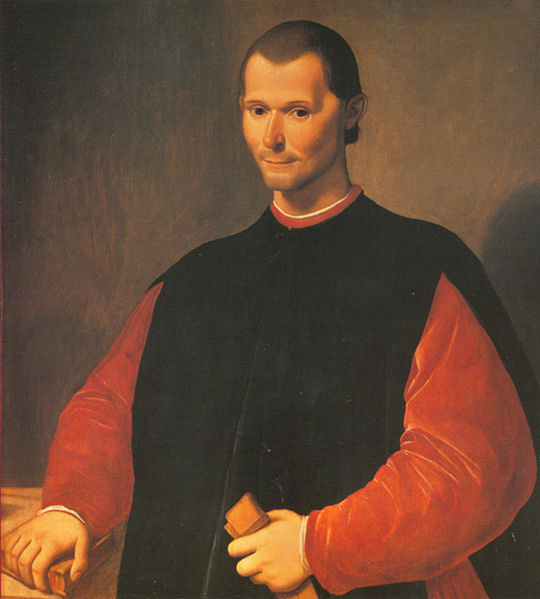
He looks so much less menacing with his eyeballs
properly filled in.


Additionally, The Prince is not the sum of Machiavelli's work. Following The Prince, he wrote another, much longer, political treatise. This one, titled Discourses on Livy, extolled the virtues of republics. In this book, he sets forth a system of checks and balances between the prince, the nobility, and the people. Contrary to the immoral behavior advised in The Prince, in the Discourses, Machiavelli states that extra-constitutional means should never be necessary in a republic (Some commentators have even suggested that The Prince is meant to demonstrate the moral superiority of republics.). He says that governments of the people are better than governments of princes. And it doesn't get more clear than this: "... if we compare the faults of a people with those of princes, as well as their respective good qualities, we shall find the people vastly superior in all that is good and glorious."

So... Machiavellian? I think there's a strong case to be made that Niccolò Machiavelli's work has been unfairly reduced to The Prince. The entirety of his political work and writings suggest he was strongly in favor of republics by and for the people. A true Machiavellian, therefore, would trust the people to govern better than a prince ever could.

Thursday, January 30, 2014

In Memoriam

On January 24, 2014, my beloved grandmother, Grandma Vel, passed away at the age of 92. I've been away from the blog for a few months and this isn't how I imagined coming back, but I hope you'll indulge me. The following post is adapted from the eulogy I wrote for her memorial.


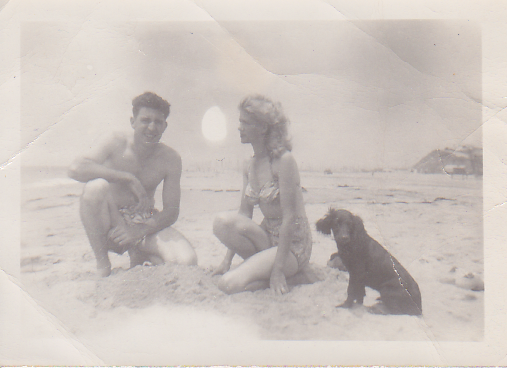
Vel in 1942, age 21

For Vel

As I thought about the memorial service, one of my first considerations was to worry about what I should wear. Even though the small service was just for our family, the occasion seemed to warrant more than my usual jeans-and-a-t-shirt wardrobe. I considered shopping for something a rung or two up the formal ladder of attire.

But then I remembered a particular Sunday morning, during one of my sister's and my summer visits to Grandma Vel's. This would have been, I believe, the summer between my seventh and eighth grade years of school. We were all getting ready to go to church. While Sis and I donned our dresses and brushed our hair, Grandma's voice erupted from her room, in one of her usual exclamations of frustration, “Oh, Godfrey!” followed by her laughter. We found her sitting on the edge of her bed, struggling to pull on a twisted pair of pantyhose. She cursed and grunted until she'd shown them who was boss, and then complained the whole morning about how uncomfortable they were. It was the only pair of nylons she owned, she later explained, and she hadn't worn them in years. The elastic had given out, so the pantyhose sagged at the ankles. Her wrestling match with them had put a run one leg, and the toe seams showed through her sandals. When we got home, she threw them away and changed back into her own comfortable uniform, jeans-and-a-button-down. It didn't occur to me until today that I might have gotten some of my fashion sense from Grandma, but I think I must have, and I know she would want us to be comfortable here.

When I think about Grandma, I remember how she always seemed larger-than-life. She was tall, with broad shoulders and a bit of a swagger in her step. Even when I'd grown taller than her, she was still something of a giant in my mind. When she was excited, the concept of an “inside voice” escaped her. She spoke loud, she laughed loud. Her heart was large and overflowed with love, especially for small animals, such as stray cats and her granddaughters. Vel took up a lot of room. She was a landmark, a destination, all by herself. Only a landscape as expansive as her much-loved Zion National Park could house a woman as brimming with life as she.


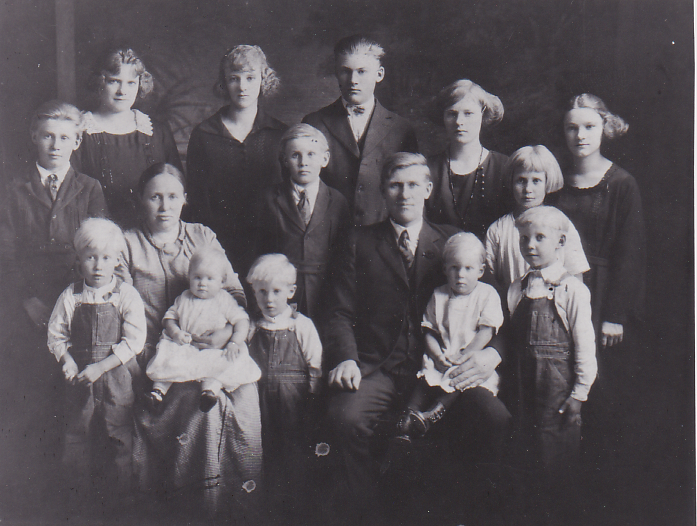
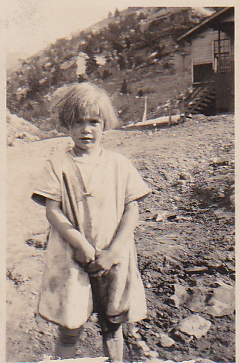
Vel is the baby in her mother's lap. Two more would be born after her.
The oldest few were already grown and gone.


1928
Vel was born in 1921, one of seventeen children, to poor Danish immigrants. She grew up in a small coal mining town in Utah that no longer exists. As I thought about what I should say in my remarks, I knew I couldn't really talk about any of her family history, as it falls beyond my area of authorial expertise. I didn't witness her bucolic childhood in Spring Canyon, nor did I watch her grow up in a tribe of sisters. As a young woman, she developed her talents as an artist and a songstress, singing on live radio to great acclaim, and painting canvases of the untamed wilderness which inspired her. She became a woman I never met, riding in a standing-room-only troop transport train for her brief honeymoon in San Francisco, and riveting bombers during World War II. I like to think we'd have been friends, had we met at a play group as young mothers, with our arms and laps and houses full of children. I look at photos from that time in Vel's life and recognize a kindred sense of harried weariness, of love and exhaustion so deeply entwined it doesn't seem you can ever pull one from the other. But I'll never know. That wasn't my experience with her.

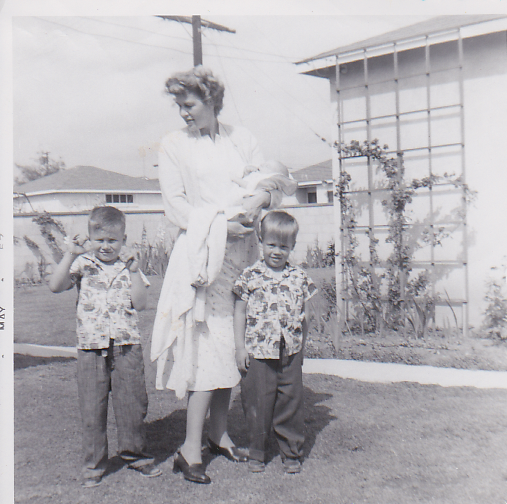
My father is the well-behaved one on the right.
Since she passed, I've been reflecting a lot on what my relationship with Vel was, and what it wasn't. I don't know what it was like to grow up with Vel for my mother. I can only imagine the family was complicated, as all families are. Vel's children would have adored her when they were young, and hated and been embarrassed by her when they were teenagers. As a parent, she probably often fell short of her own desires, and her children's expectations. This is the way of being a mother.

I don't know what it was like to have Vel for a mother-in-law. Mom always spoke of her with fondness and respect. Maybe everything was smooth sailing between them. Maybe there was some underlying judgment and animosity I never knew about.

To me, she was always Grandma Vel. In all of my life, she is the only person from whom I have ever felt complete and total acceptance. I believe it must be the prerogative of grandparents and grandchildren to find in one another not just the potential for, but the fulfillment of, perfection. Vel used to praise Mom's late mother, Liz, as a paragon of ladyhood. She admired Liz's genteel manners and said she felt like “a bull in a china shop” next to her. But to me, her brash ways were every bit as instructive in the art of Womanhood as Liz's more subtle, cultured example.

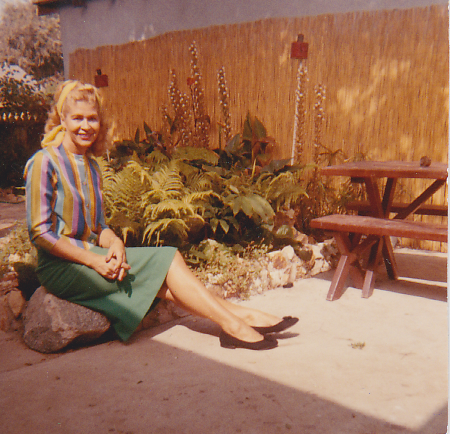
1962, still waiting for Nelson Eddy to sweep her away.


From Vel, I learned that that the simple pleasures in life were just as marvelous as the finer things, that an evening at home playing cards and sipping margaritas was the best thing in the world, as long as you spent it with the right people. She taught me a woman should never leave home without three essentials: her lipstick, so she'd always be presentable; some tissues, useful in civilization or the wilderness; and chewing gum, so your breath will be fresh, in the event your dream Latin lover suddenly materializes at your side.

Another family pet. This one she called Fury,
presumably because she'd trained him to tear the faces
off of intruders. Don't let the fluffy ears fool you.
On the same summer holiday I mentioned at the beginning of my remarks, when Vel wrestled with and discarded those hated nylons, we had one of my first mature heart-to-heart discussions on the subject of spirituality and religion. I don't remember how the conversation started; I probably asked her why she so rarely went to church. But I remember well her telling me that she felt closer to God when she was out in nature than she ever did inside a building. Vel didn't need organized religion telling her how to find God. Her deity was all around her in the mountains. He was in the yard she worked so hard to make beautiful. He was in Mop and Sandy, her dear little dogs. Even though it was different from how she'd been raised, and from what some of her children came to embrace for themselves, Vel found a spiritual path that fit her perfectly. A little bit Christian; a little bit Pagan; a little bit Pantheist. As far as I know, Vel didn't have a word for her beliefs, and she didn't need one. It was something just for her, and it didn't matter if anyone else in the world agreed with her. She taught me that's it's ok to break from convention, and to hold fast to what is right for myself.

I have frequently said that I feel like an imposter grownup. Sometimes, I feel as insecure as I did in high school, and I'm sure that one day, some government agents will turn up at my door and charge me with impersonating an adult. But then I remember Grandma Vel, and how she never felt her age, either. Even in the last few years, when she was living in a nursing home and mostly confined to a wheel chair, she groused about being surrounded by old folks. Vel never got old. She took French lessons and learned to use the computer and socialized with her friends, refusing to let something as inconsequential as the passage of time put a damper on her enjoyment of life. She showed me that I may not be able to escape the indignities that come with age, but I never have to feel—or be—old.

Vel, on the right, with one of her sisters (center)
and a childhood friend. Vel never lost her youthful
sense of fun.


In return, my sister and I provided Vel with a constant source of grandparental pride. She thrilled at our good grades. She thought we were beautiful. She invited the neighbors over to coo at our sweet, Southern accents. She called us by the endearments Little Sweet, or Living Doll. Even the one time I recall her wanting to fuss at us for sneaking out of bed and staying up late was turned around when she discovered we'd broken bedtime to secretly bake a cake for her birthday the following day. Her disappointment in our behavior was turned to surprised delight in the blink of an eye.

She loved us the way she did everything, big and loud and a little bit unruly. I know neither Sis nor I will ever forget the time we broke down on the side of the interstate on our way to catch our flight home from Vegas. Grandma's one-armed neighbor, Ann, gave us a lift. We stopped at a casino in Mesquite, Nevada for lunch. Vel and Ann got carried away on the slot machines, so we were late getting back on the road. When the car broke down a short time later, in the middle of the Nevada desert in the middle of a hot, summer day, the time crunch made it an even greater catastrophe than it would have been otherwise. But Vel didn't hesitate in her purpose. She knew she had to get her babies to the airport, and so she flagged down a perfect stranger and commandeered his vehicle. My sister and I perched on the piles of paperback books in the backseat of his car while Grandma hopped into the front passenger seat and ordered the man to drive us to Vegas. Damn if he didn't drive us a good hour and a half, right to the curbside dropoff at the airport, never once protesting Grandma hijacking his car and his time.

Vel was proud of my efforts as a writer. When I sent her a copy of Once a Duchess, she locked everyone out of her room at the nursing home while she spent the weekend reading, so she could call me on Monday to discuss the novel. She told me that she showed it off to all the residents and staff.


The author and Vel in 2011. I smuggled tequila into the nursing home to
make her a proper margarita. A fine time was had by all.


She even praised my mundane accomplishments. When the eldest Master Boyce was two months old, Mom and I took him out to see Grandma Vel for Thanksgiving. One afternoon, we left her home with the baby, with a bottle of pumped milk to give him when he became hungry. She repeatedly marveled over and complimented the cream content of the milk, as though I had personally invented the perfect food for infants. Everything I did was really and truly wonderful, and to me, she was every bit as perfect.

Because Grandma Vel lived so far away, visits were always an event. In my mind, Grandma Vel will always be a vacation. She's a special holiday of mutual adoration and affection, smelling of White Linen and dusty, Western skies. She is soaring mountains and horseback rides. Rock shops and bumbleberry pie. She is Good and Plenty candies, licorice nips, and a drawer full of reused aluminum foil. She is lava rocks and zoysia grass, apricots and cherries. She is her wonderful paintings, her extraordinary voice, and her unfettered enthusiasm for living.

My time with Grandma Vel is like a strand of pearls, each occasion beautiful unto itself, but becoming more precious as they are gathered together, becoming a rare and precious heirloom on the silken strand of my life.

Monday, October 28, 2013

Big News for the Once Series

I am thrilled to share some exciting news with you! The response to the Once series in ebook format has been so wonderful, my babies are getting a print run!

Just so we're clear, I'm the happy, dancing pig.

Once a Duchess, Once an Heiress, and Once an Innocent will be released in trade paperback, available for purchase in-store at Barnes and Noble. One book will be released each month, beginning with Duchess's release on December 18. It's available for pre-order right now on Amazon and Barnes and Noble.

Thank you to Tara Gelsomino, my fantabulous executive editor at Crimson Romance, for making this happen. And a super huge deluxe THANK YOU to my amazing readers for loving these books and for asking when you'll be able to pick them up in the bookstore. Soon!!!

Monday, October 14, 2013

At the Library

“We don't really market to libraries. We don't want readers to get the idea that they don't have to pay for content.” – Representative From a Publishing Company Which Shall Remain Unnamed

As I write, I'm sitting at a table in the corner of the non-fiction section of my local public library. My plan for today is to get lots of writing accomplished, which means I need to get away from the internet. Turning off my wireless at home doesn't always cut it; it's too easy to turn it back on. So I need to be somewhere else. I need to be at the library.

Then how are you posting right now, genius?

While preparing for my day, I remembered hearing the quote I posted above. I was at a workshop hosted by a particular publishing house, listening to a presentation meant to sell authors on why this company is the place to be. Things were going along okay, until someone in the audience asked what kind of penetration the company had with libraries, and one of the publisher's representatives said … that.

It was one of those moments when my jaw quite literally dropped. I couldn't believe someone whose business is books could so casually brush aside the entire concept of public libraries. We don't want readers to get the idea that they don't have to pay for content.

Holy – pardon my French – merde.
* * *
I've been addicted to books from the beginning, and while my childhood room had a little shelf crammed with many of my favorites, the library was the primary supplier of my drug of choice. Every time my mom took us there, I exchanged one heavy pile of books for another. It was nothing for me to leave with five or ten or more. My parents never could have afforded to purchase all the reading material I tore through.
Fine, Baby Jesus. We'll read Goodnight Moon. Again.

To be sure, they bought me plenty of books over the years. For my birthday, for Christmas, for just because. When in doubt, a book was always (and still is) the perfect gift for me. Still, the sheer volume of them I consumed... If I were to add up the cover prices of every book I have read in my entire life to this point, the total would probably sustain a small country for a year.

My first act of scholastic misfitery happened in the fifth grade. Being the top of the elementary heap, fifth graders were assigned various responsibilities around school. I was put on the safety patrol, which came with a neon orange sash and the power to enforce hallway rules of orderly conduct. It was a prestigious position. Being the visible face of authority is heady stuff for a ten-year old.

But it wasn't good enough for me.

You see, another position given to fifth graders at my school was that of Library Helper. I was wildly jealous of my library-working peers. So one day, my stomach roiling and palms sweating, I got up with my Library Helper classmates when they left for their duties. I lied right to Mrs. Anderson's face, and told her I'd been asked to be a Library Helper, too. I slipped into the library with the rest of the group, pulled an identification button from a basket, put it on... and I was in. I was a Library Helper.

I must have lied to the librarian to explain my presence, as well, since fifth grade tasks had long since been assigned. Either that, or no one was going to raise a stink about a rebellious act of volunteerism. A friend showed me the ropes, and soon I was shelving books, sorting media materials, and working circulation like a pro.

My favorite task was processing new books. To reach into a cardbord box, pull out a shiny new book, and be the first person ever to open it was a rush like nothing else. Wielding a rubber stamp, I branded each new book with the name of our school. There was a system to it: Inside of the front cover, page five, page thirteen, etc., inside of the back cover. I carefully adhered the manila pocket that held the circulation card for each book into the back cover, as well. Then I prepared the card itself. I scribed the book's title across the top of the card and, armed with one of those wonderful, heavy stamps constructed of metal, with rolling gears and that satisfying ka-chunk noise, I memorialized the date the book was introduced into the library. Now it was ready to be released into the library wilds, there to wait until a child picked it up and discovered a new world. And I was part of this magnificent thing.

We don't want readers to get the idea that they don't have to pay for content.
* * *
A man has taken the table beside mine. He's wearing a long-sleeved chartreuse shirt and a bow tie. He seems to be dressed for work, and I wonder if he's just passing the time here while waiting for a business appointment. There's a pencil and a highlighter on the table, too, so maybe he is at work, like me. A cup of Starbucks is sitting at his elbow. Three paperbacks are on his table; he's looking through one of them. He has a little laptop computer, too. He spent some time on it, but now it's closed.

And here's my table.
Suddenly, I'm wondering how many of us there are, officeless workers who make the library our temporary base of operations on any given day.

Plenty of writers like setting up camp in coffee shops, but that isn't really my scene. Coffee shops are noisy, plus there's the understanding that you should actually spend money there. It's rude to take up space in a cafe without patronizing the business. And I get that. I do. But the library doesn't want anything from me. No one is going to give me a dirty look if I sit here for three hours without making a purchase. If I need to stretch my legs, I can stroll the stacks. If I'm thirsty, there's a water fountain.

When I came to the library's website this morning to double-check the hours of operation, I noticed the calendar of events in a sidebar. Several times this month, there will be sessions offered to help members of the community navigate through the new Insurance Marketplace. There are computer literacy courses. A class on researching family history. Star gazing parties. For the children, there are puppet shows, movie days, story times.

The library is part of the community. It doesn't just offer books to anyone who wants to read, it helps the public lead richer, better informed lives.

We don't want readers to get the idea that they don't have to pay for content.
* * *
Creative writers sometimes say they don't write for the money. That's mostly true. I would write no matter what, whether or not another pair of eyeballs ever saw my words. I've written for most of my life, but have only been published for one year out of the … lots … since I learned how to form letters. In the grand scheme of things, my life as a published novelist is a blip on the screen. But the truth is, I'm a writer who is trying to build a career as a published author. And publishing is a business. That means I have to care about sales and money and marketing and all sorts of stuff that has nothing to do with the writing.

But the point of being published, to me, is getting my work to readers. It's sharing my stories with other people, and hopefully contributing something meaningful to their lives. If people get my books by purchasing them, wonderful. Awesome. Every sale is humbling, and I am so, so grateful to each and every one of you who has financially contributed to my fledgling career. But I'm just as grateful to those who have told me, “I got your books through my library.” To them, I have said, and will continue to say, “Thanks for supporting your local library!”

I love my readers, no matter how they find my books. It's just as thrilling for me to see my books in the catalogs of libraries all around the world as it is to see my sales numbers slowly increasing. Knowing that libraries carry my work is just amazing. I'm right back in the fifth grade, reveling in being connected to something as utterly fantastic as libraries.

King George, tear down those library doors!
Public libraries are one of the few truly democratic institutions in our society. It is open to absolutely everyone. The knowledge inside these walls is on offer to any person who cares to avail themselves of it. Right this minute, there is more information packed inside this building than the average person was ever exposed to over a lifetime, just a few generations ago. My library isn’t particularly grand when compared to lots of other places, but there are still more books here than I will ever read, and more coming in all the time. It doesn't matter if you're a billionaire or a nickelaire, the library is yours to use.

There have been times in my life of financial hardship, when I could not afford to purchase books. No one here asks to see my bank statement or last two pay stubs before letting me check out materials. Aren't hard times like those precisely when we need libraries the most? With nothing more than the trust that I'll bring them back again, I'm permitted to take home as many books as I want. I get to escape my troubles for a little while. The library has been an oasis when I desperately needed one. It has given me more enjoyment than any other institution I can name. How could I ever, ever begrudge anyone that same joy now that I'm part of the publishing industry?

So when that person said, “We don't want readers to get the idea that they don't have to pay for content,” what I heard was, “We don't want readers.” I scratched that company off the list of publishers I would consider working with. I care about readers. I want readers.

As a reader, I will forever love the library for making it possible for me to discover and experience so many amazing books. And as an author, I will always champion libraries. My novels belong there, where anyone who cares to read them can.

Tuesday, October 1, 2013

Extra

Today I went to the grocery store to pick up a few things. As I pushed my cart past the deli, another shopper drew my eye. She had a long, blonde ponytail. I recognized her from my yoga studio. A couple months ago, she came to the Sunday morning class I normally attend. Her brother came with her that day. He complained about tight hips. She borrowed a studio mat, while her brother used hers. I've only seen her in class the once, but she chatted familiarly with our instructor, so I think she's a regular at the studio, just not at that particular session.
Carol! I'd recognize that smile anywhere. How are you, dear?

I circled through the produce department, collecting my carrots and tomatoes and green leaf lettuce, while this woman strolled through the fruits. I wondered if she recognized me, too. The Pringles and Coke in her cart surprised me. In yoga class, she was the student everyone envied, even though There Is No Competition In Yoga. If I'd spent any time picturing her life at home, it would have included a super clean diet, possibly vegan, certainly gluten-free. Shows how unimaginative I am. Now I knew two things about her, that she can do beautiful flying splits, and she eats Pringles. Also that she has a brother with tight hips.

All these thoughts tumbled through my head in the produce department, and still, she never looked my way. I spent some time at the bagged salads, pulling them out of the refrigerated case and scrutinizing them for the slimy brown beginnings of rot. At the same time, the woman from yoga class studiously considered the nearby fruit salad offerings.

I sort of wanted to walk over and talk to her. But what would I say? "Hi. I don't know your name, but I recognize you from yoga. We once shared space in the studio, and your brother was kind of terrible at pigeon pose. Not that I judge him for it; I know he has tight hips."

How strange would that sound? In the end, I didn't feel I had the right to speak to her. I realized I was just an extra in her life. If her credits had rolled that morning in the yoga studio, I would have been Yoga Student #3. Today I was Woman Agonizing Over Spring Mix.
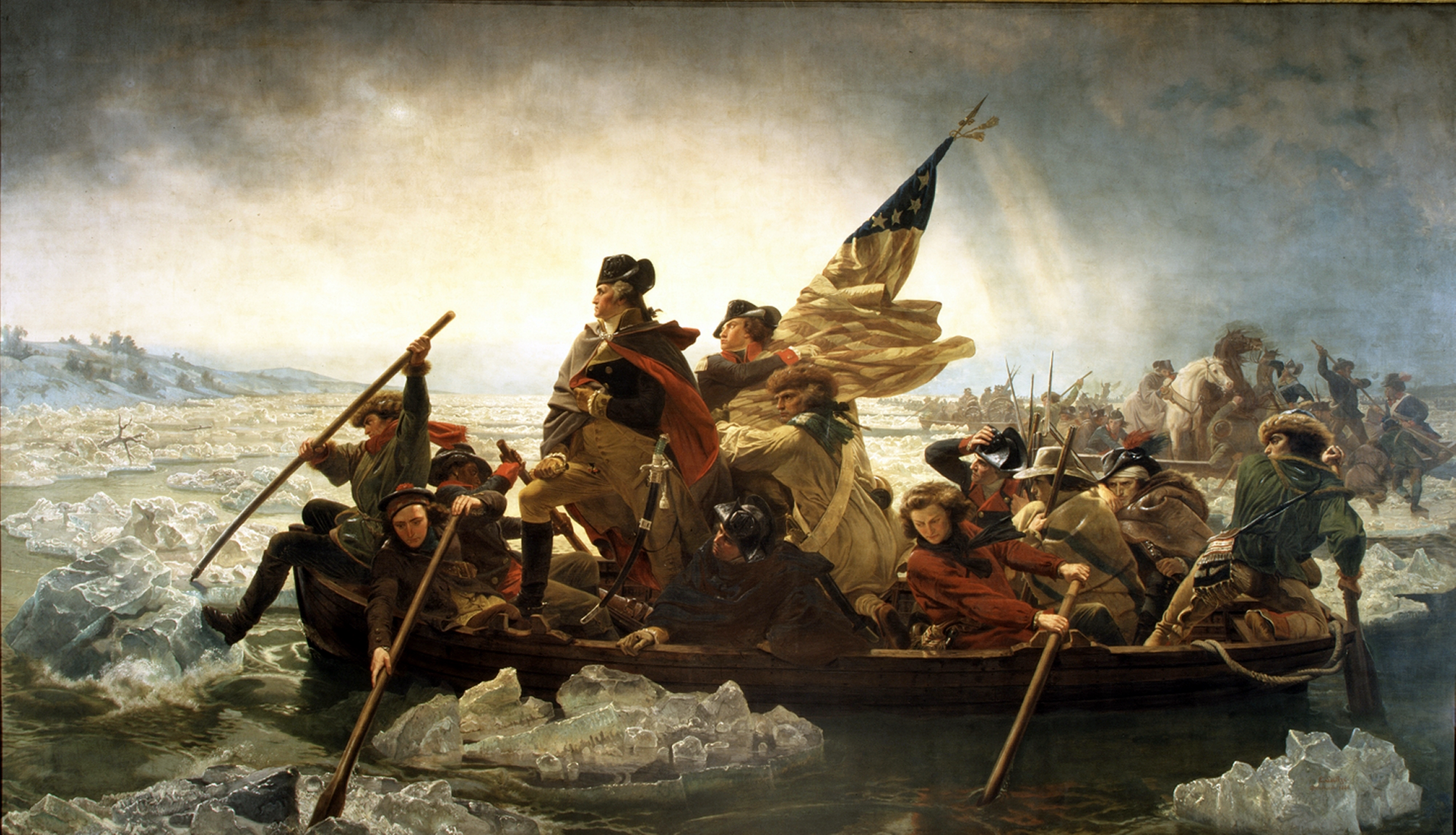
Did you ever stop to think about the trio huddled in blankets in the back?
What's their story? I bet it's good. And the oarsman in red? Most
interesting guy in the boat.

I thought about that. Here I am, a fully realized human being, reduced to filler in another person's episode. Just an unremarkable face in the background. I considered the fact that I recognized her, but she didn't recognize me back. Rather than take offense, I wondered how often I'm guilty of failing to see the people around me, the bodies who serve as my own extras. Do they sometimes recognize me? Do any of them know I have a weakness for Nutella and children who incessantly tattle on each other?

And all of them, from Man Arguing On The Phone to Elderly Woman Ordering Tea to Yoga Student #5, they aren't really extras, any more than I am. We're all part of a glorious, ensemble cast. I have 7 billion co-stars. I know this, but sometimes it's good to be reminded. Next time I'm out, I'm going to try to pay more attention to people than I do to my produce.

Monday, August 5, 2013

I Get Questions!

Sometimes I get notes from readers, telling me they enjoyed my books (yay!). Often, there are questions in there, too. So often, in fact, I have seen a trend of frequency. One might be so bold as to call them Frequently Asked Questions. While I'm always happy to respond to notes from readers (yay!), I thought I might start compiling an actual FAQ. Or a running FAQ, with new posts written as I accumulate more questions. Or something. Whatever. We'll figure it out as we go, shall we?


No, Dick, this will not be on the quiz.


QUESTION: Will there be any more books in the Once A... series, following some of the other secondary characters?

ANSWER: This is, by far, the question I receive most frequently. First of all, it warms the cockles of my authorial heart to know readers feel a connection to my little Regency world and its inhabitants. So, a super huge thank you to everyone who has asked me this question. Thank you for reading. Thank you for caring. I *heart* you forever and always.

The Once A... series was originally conceived as a trilogy. I wanted to follow three friends: Isabelle, Lily, and Naomi. Their stories became Once a DuchessOnce an Heiress, and Once an Innocent. Mission accomplished!

Except...

As I told my ladies' stories, I met some gentlemen along the way, guys who are now giving me the Meaningful Look a character gives an author when he wants to impress upon her his feelings of neglect and impatience. Grant Lockwood, the middle sibling of the Lockwood clan, and Alexander Fairfax, Isabelle's older brother, are definitely on the list. Those two have been riding around in the back of my head for a while now. There's another man who's captured my imagination, too, one a little darker, a little more dangerous. If you've read all three of the Once A... novels, you might guess his identity.

At this point, I have nothing in the works for these fine fellows, but I'd like to get to them eventually. I cannot commit to anything regarding a timeline as to when you might see their books, because I don't have so much as an outline for these stories. I don't know if they will continue the Once A... series, or if they'll get a trilogy of their own, or if they might be stand-alones or mixed up with other series... No commitments! Just know that I've heard you, and I want to know their stories, too.

QUESTION: What's next? More Once A...?

ANSWER: Dang it, people, we just talked about that! 

OK, "What's next?" is fair. Here's What's Next, including a rambling story, because that's how I do.

You see, when an author is just starting out and doesn't have a contract anywhere and doesn't know if her stories will ever see the light of day, she spends a lot of time second guessing herself and wondering if she's Doing It Right. Say, for instance, this author was working on a trilogy. Say she'd finished two manuscripts and had the third underway, but hadn't managed to place the first one yet. Say she was starting to question whether she was wasting her time on that trilogy. All the advice says to keep going, to write the next thing, and the next, and the next. But maybe she was spinning her wheels on that next thing and needed to do a whole other, different thing.

I know there's no fooling you, my keen reader. That hypothetical author was, in fact, moi. When I'd gotten about halfway through the manuscript that became Once an Innocent, I set it aside and started something new that wasn't attached to my trilogy, so I'd having something else to shop around in case Once a Duchess didn't sell.

That manuscript is called Anatomy of a Deception (working title). It's a Regency-set romance about a genteel young lady turned body snatcher, an ambitious London surgeon, and the anatomical specimen they both have to obtain... But the body is still alive.

It's got a gothic atmosphere, a little darker in tone than the Once A... novels. It took second place in last year's Fire and Ice competition (historical romance category).

Wouldn't you know it, though, when I was about halfway through that novel, my Once A... trilogy was picked up by Crimson Romance. So, I put Anatomy on the back burner and got to work on my edits for Duchess and Heiress, as well as finished writing Innocent. And edited it. And learned about marketing and publicity and being a published author.

I finally got back to work on Anatomy of a Deception. In addition to that one, I penned a little novella called The Ruination of Miss Claudia Baxter, about a plucky young woman and the desperate lengths she goes to to avoid her arranged marriage. Those are both being spruced up in preparation for finding homes. I hope to have some news for you on that front soon!

I've got ideas for several series, each consisting of at least three novels, as well as a couple other stand-alone novels. The work I've laid out for myself should keep me busy for at least the next decade (and the ideas don't stop coming!), so I hope you're wearing your comfy pants. We're going to be here a while.


That's enough Q&A for today. If there's a question burning a hole in your heart, leave it in the comments below, or feel free to write. I love hearing from you!

Tuesday, July 23, 2013

RWA 2013 Roundup

Last week, Romance Writers of America (RWA) got together for the annual national conference, held in Atlanta, Georgia. This was my first year in attendance. It was uh-mazing.

I had my very first fan sighting--meaning I was sighted by a fan. Right after signing in at the conference registration desk, I hit the ladies room. While I was washing my hands, a woman at the sink next to me eyed my badge and did a double take. "Are you one of my authors?" she asked. I thought she must have been with my publisher, or perhaps one of the industry professionals I had scheduled meetings with. It didn't even occur to me she might have been a reader. "I don't know," I said. "What's your name?" "Sophie," she replied. No bells rang. "Who are you with?" I asked, still trying to place her in a professional context. "Facebook!" she replied. Then she gushed about how excited she was to meet me, and how she hoped to meet many more of her favorite authors. What a great start to my conference! Sophie, wherever you are, you totally made my day.

Wednesday evening, we hosted a Literacy Book Signing. Over 400 romance authors (not me--maybe next year!) signed books for avid readers. All proceeds went to several literacy charities. I met romance readers who had traveled hours to meet their favorite authors. Being published in the genre doesn't squash the fangirl in me... it just gives me more frequent access to my own idols.

l-r: Tessa Dare; Fangirl Grinning her Fool Face Off

Mary Jo Putney, who wisely advised we take two pictures.


In addition to the marvelous Tessa and Mary Jo, over the course of the conference I met huge names in romance like: Eloisa James, Jo Beverley, Eileen Dreyer (who I gushed over, and who was very laid back about it), Cathy Maxwell (who I cried on, and who was very kind about it), Kristan Higgins (who I accosted with a hug, and who hugged me back).

Besides the New York Times bestsellers you all know and love, I got to hang out with lots of writing buddies, new and old: Synithia Williams, Kwana Jackson, Micah Persell, and so many more.

There were cocktail parties and luncheons with uplifting and powerful speakers.

And--oh, yes!--the workshops. Approximately five zillion workshops jam-packed with information on craft, marketing, research, and career paths. Spotlights on individual publishing houses. More book signings (I came home with over 40 novels. I might have a little problem.). Parties, open houses, awards dinners... and I didn't even make it to the RITAs, our industry's version of the Oscars, recognizing the best romance novels of the year. One of the Boycelings was bound for summer camp, so I scooted out of conference a few hours early to get in some snuggle time before he left.

Y'ALL. No wonder I'm still worn out. What a great conference it was. If you enjoy reading romance novels, keep your eyes peeled for a conference near you (in 2014, RT will be in New Orleans and RWA will be in San Antonio). Those are your chances to rub elbows with your favorite authors and take home the best new releases. And if you're a romance writer, I really can't emphasize enough how worthwhile it is to attend these events. I came home re-energized and brimming with inspiration for my work.