Thursday, June 28, 2012

Easily Impressed

I'm currently vacationing with the extended family on a barrier island off the coast of the southeastern United States. Seeing as I'm on holiday, I've been hoping to write another entry in the Regency Holiday series. Never fear, that's coming soon, but not what I'm here to talk about this evening.

Mr. Boyce and I just came in from a walk on the beach and-- 

Can I just take a second to tell you how much I love the ocean? I used to dream of becoming a marine biologist, until I realized I possess no aptitude for science. Still, I think the ocean is absolutely amazing. I need it in my life. I don't live on the coast, but it's somehow comforting to know the ocean is only a couple hours away by car. I wouldn't choose to live in a landlocked state. There needs to be a big mass of blue on one side of my state's map.

Oh, look at the sweet ducks! I love the way they look and sound and...
Does anyone else even notice the ducks? What if I'm the only person
in the world aware of these ducks? Why do these ducks have the power
to throw me into existential crisis?
Back to my stroll with Mr. B. We didn't travel very far. Every few steps, we stopped to examine what was happening around our feet. He found some gorgeous, large shells this morning and I hoped to match his beachcombing skills. I picked up a broken chunk of scallop shell. There wasn't anything special about it. The shell was a bland gray. Flipping it over, I found a cluster of tiny, volcano-shaped structures. "Hey! It's got barnacles!" For a second, the fact crossed my mind that after the animal inhabiting that shell died, other animals made it their home. They lived their lives and died on that same, boring scallop shell. I tossed it back into the water.

Flashback:

Earlier in our holiday, I dug in the sand with the eldest Master Boyce. I found an oyster shell riddled with holes, eaten away by water and time. "Isn't this amazing?" I asked my son. "We can just reach down and pick up something that could be hundreds of years old." I was't faking the tone of wonder in my voice. That really is amazing to me. He grunted.

Return to present:

A short time after the barnacle incident, I spotted a pod of dolphins not too far offshore. Their wet skin flashed reflections of the sinking sun as they undulated through the water, lifting their rounded backs above the waves. Each tantalizing glimpse of fin or blown water was special. To me, they seemed like a row of sentinels patrolling the shore, keeping sharks away from swimmers enjoying the shallows.

Mr. B and I watched them until they passed. Smiling, I turned and looked around, sure my fellow beach goers would be likewise enraptured by the visiting wildlife. But no. People splashed in the water, lazed in the sand, chatted with friends. No one else seemed to have seen the dolphins. Maybe they just didn't notice them, I thought. 

"Dearest, I have a sinking suspicion these other
people are, well, dullards."
On our return leg of the walk, however, I wasn't able to give them the benefit of the doubt. A military helicopter passed overhead. Instinctively, I craned my neck to watch it. I spotted a red cross on a white square. "Medics," I informed Mr. Boyce. Turning to see his nod of agreement, I noticed that, yet again, no one around us paid any attention to the interesting sight. A very large, very loud helicopter flew right over us, and people seemed not to care.

For some reason, this really annoyed me. Who are these people who don't notice the world around them, who aren't spellbound by dolphins or transfixed by huge aircraft? Am I the different one to imagine the passing years in a barnacle-encrusted scallop, or to hold in reverence an age-ravaged oyster? It's all so impressive! I am often overwhelmed by the amazing world around me. Its people and history and natural majesty. Why isn't everyone as entranced? Is this my creative mind at work? Is it only my internal writer concentrating hard, picking out details in the way the retreating waves pull the sand out from between my toes?

Sometimes I feel a bit disconnected from humanity. When I can't even imagine why these marvelous things don't impress everyone, I wonder if I'll ever understand other people. Maybe writing is my way of trying to do that, to see the world through other eyes. Although I still don't know if I could write a character who fails to be impressed by dolphins.

Wednesday, June 20, 2012

Publication Announcement!

I am thrilled to announce that my debut Regency romance novel, Once a Duchess, has been contracted for publication by Crimson Romance!

Here's a blurb:

Isabelle Lockwood was a duchess, until her husband of only a few months wrongfully divorced her for adultery. Since then she's been a pariah, living in anonymous exile to escape the prying eyes and wagging tongues of the ton. More than anything, Isabelle longs for children of her own, and so has to marry again. But society is ruthlessly unforgiving. To clear her name, Isabelle must face down her past—and the man who broke her heart and ruined her completely.

Marshall Lockwood, Duke of Monthwaite, was blindsided by his young bride's infidelity. After the divorce Marshall licked his wounds, throwing himself into his botanical studies to forget his disastrous marriage. Now his former wife is back in Town, as beautiful and enticing as he remembers. As the Season throws them together again, Marshall can't shake the feeling that Isabelle might not be the adulteress he took her for.

The question I keep getting is: "When will it be published?" I appreciate the enthusiasm! At this time, though, I don't know. Rest assured, I will let you know when I have a publication date.

Wooooooo!


Thanks so much for your support!


Friday, June 15, 2012

Regency Holiday: Bath

Summertime, and the living is easy....

Here in the northern hemisphere, the warmth of June has turned many a mind to visions of the seaside, mountains, open country, islands, campfires, and drinks with umbrellas. As summer progresses, we'll evacuate cities en masse and escape to less densely populated climes. We're going on holiday. Finally.

The denizens of Regency England loved going on holiday, too. In fact, the idea of tourism really hit its stride during the Regency, as improvements in transportation (both roads and conveyances) made travel easier and more accessible to a wider portion of the population. The haut ton had been gallivanting all over Britain and the Continent for ages, of course, but during the Regency, even the less wealthy gentlefolk were smitten with the notion of holidays and tours.

A sea horse. Oh, those Romans and their
visual puns!
Today, we're traveling to Bath, a city located in Somerset, in southwest England. Set in the valley of the River Avon (of Stratford-upon-Avon fame), Bath is famed for its hot mineral springs, which have drawn visitors since ancient times. The Romans officially established Bath as a city (then called Aquae Sulis) in AD 43. Romans had been building bathing establishments all over the Empire for centuries, so it was only natural that they should plunk a bath house right on top of the only hot spring in England.

Bath's mineral waters had long been thought to hold healing properties. For centuries, it was a destination for those afflicted with every sort of physical complaint. In the eighteenth century, a gentleman by the name of Beau Nash acted as Master of Ceremonies for Bath, and worked to establish Bath as the premier spa resort in England. He was seemingly everywhere in town, greeting new arrivals, warning tourists away from medical charlatans and card-sharks, escorting ladies to balls, and even matchmaking. Nash encouraged a more casual social scene in Bath, wherein the classes mingled more easily than they did in London. By the Regency, Bath's popularity with the aristocracy was on the wane, but it remained a favored spot for those who had visited during Nash's time, as well as with invalids come to "take the waters" for their curative effect.

The Grand Pump Room, not to be confused with the
Mediocre Pump Room.
A typical day in Bath started fairly early. At 8:00, patrons could go to the Pump Room to drink their daily dose of mineral water. It tasted revolting, but one's medicine must be consumed, so down the hatch it went. After that, those seeking healing would head to the baths themselves. People with open wounds sat in the same water as patients afflicted with infectious diseases and gout. The resulting stew probably did more harm than good, but I'm sure it felt nice. A great number of physicians, surgeons, and apothecaries set up shop in Bath to cater to sick tourists.

That water looks delicious.
For those not convalescing, Bath offered a wide array of diversions. There was fine dining, the Theater Royal, concerts, shopping, and a promenade. Open country lay just outside town limits for the horse enthusiast to enjoy a good ride. The Bath Assembly Rooms boasted a card room, a tea room, and a ballroom called the Octagon.

Jane Austen lived in Bath for nearly a decade. Two of her novels, Northanger Abbey and Persuasion are set in and around Bath. She was not overly fond of the town, finding the society there to be rather superficial. However, when her brother Edward's gout required he take the cure, she was confident in the water's ability. She wrote in a letter to her sister:

'He was better yesterday than he had been for two or three days before...He drinks at the Hetling pump...is to bathe tomorrow.' And... 'Edward has been pretty well this last week, and as the waters have never disagreed with him in any respect, we are inclined to hope he will derive advantage from them in the end'.


I hope you've enjoyed our brief jaunt to Bath! Throughout the summer, I'll be blogging about more Regency holiday destinations, so check back soon to see where our travels take us next.


Wednesday, June 6, 2012

Lessons From Mars

As Venus crossed the face of the sun yesterday, a literary giant's light faded from our earth.

Ray Bradbury, author of dozens of novels and hundreds of short stories, passed away last night at the age of 91.

When I saw the news today, I was immediately saddened by our collective loss of this creative genius. Soon, I began reflecting on my experience with Bradbury, and what his work has meant to me as a person and as a writer. I've read shamefully little of his vast output, but what I have read changed me forever.

1920-2012

My first exposure to Mr. Bradbury came in the eighth grade, when my English teacher assigned Fahrenheit 451. How many of can say the exact same thing? Quite a few, I imagine. This dystopian novel, published in 1953, is recognized as part of the literary canon. It's become the default example of state-sponsored censorship. Firemen come not to extinguish conflagrations, but to burn books. Book lovers live in exile in the wilderness, fugitives from a society that suppresses the thought-provoking ideas found in literature.

You know who loved censorship?
Nazis, that's who. They aren't even toasting
marshmallows over those burning books.
What a waste!
Much to the consternation of many an English teacher, Bradbury himself said the novel's main theme was not censorship, but the impact of television and other mass media on the reading of books. Recall the enormous, flat screen televisions that filled three of Millie's parlor walls. Interactive programs were the primary form of entertainment in 451's vision of the future. Now recall our own large, flat televisions and the central place they have in our living rooms, our highly interactive video games and vote-for-your-favorite-contestant shows. As early as 1953, at a time when there were only a few television networks on the air--compared to the hundreds available today--Bradbury saw this technology's potential to encroach on both our reading time, and our level of interaction with the people sitting around us. Consuming media together, instead of lively conversation, is our great communal experience.

Like everyone else, though, I came away from reading 451 with a profound aversion to censorship. My own feelings on the matter go beyond government-sanctioned censorship. I cannot abide censorship of any sort. Even the purveyors of the most repugnant, detestable ideas deserve the equal opportunity to put their ideas out into the world. This is not to say ideas should be immune to criticism. Not at all. Response in the form of agreement or criticism is a healthy part of the free speech process.

The Martian Chronicles is the other major Bradbury work that left an indelible mark on me. The volume is a collection of Bradbury's Martian tales, originally published as stand-alone short stories in various science fiction magazines. He stitched them together with the addition of a few new stories and vignettes, and the collection was released in 1950 in the form we know it today. Collectively, The Martian Chronicles tells the story of the colonization of Mars by humans and their conflict with the native Martian population. Failed expeditions and ambushes by the aboriginals invite comparison to the European colonization of the Americas and Africa. It is easier, perhaps, to contemplate the morality of colonizing an inhabited land when presented with a fictional setting, rather than reflecting on a fait accompli such as our own history here on Earth.

The stories from The Martian Chronicles have stayed with me, lingering always just on the edge of my awareness, in the almost twenty years since I first read them. There are times when I top a hill in the countryside, and am instantly taken to Mars, to "The Green Morning."

All about, like a moving current, a mountain river, came the new air, the oxygen blowing from the green trees. You could see it shimmer high in crystal billows. Oxygen, fresh, pure, green, cold oxygen turning the valley into a river delta.

I'm telling you, this is a great spot for a hot dog stand.
The image these three sentences evoke is magnificent. Although we read them in the context of mankind molding the natural Martian environment into one better suited to the needs of humans, they remind us of the vital service trees perform every second of every day. We see in the oxygen-starved humans on Mars a reflection of ourselves in a world of diminishing natural resources and ever-increasing levels of pollutants in our atmosphere. When I see a landscape covered with trees, I picture the waves of oxygen billowing out of them, nourishing and replenishing the air.

"Usher II" creates a lush, Gothic atmosphere. I can never forget the recreation of literary horrors used to dispose of pesky Moral Climate Monitors. The final image of the house sinking into the ground after it has fulfilled its purpose is one that stays with me, too. Interestingly, this is Bradbury's anti-censorship story. Some backstory tells of a Great Burning of books, Fire Crews who incinerate them, and secret groups who collect and protect them. These will all appear again in Fahrenheit 451, of course--the novel which is most emphatically not about censorship.

"There Will Come Soft Rains" gives us a haunting, poignant glimpse of a post-nuclear war world without people. For a time, technology carries on, but nature ultimately reclaims her own. Finally, "The Million-Year Picnic" closes with a human family who has escaped the ravages of nuclear war on Earth and the troubles on Mars. They choose an abandoned human town on Mars in which to live, and then the father introduces his children to Martians: their own reflections in water.

Ray Bradbury taught me to actively love books, to cherish and protect the written word. He taught me the perils of censorship and to reject it at every turn. He took me to a distant planet, only to force me to confront problems here on Earth. Under Bradbury's guidance, I pondered ideas like racism, colonization, genocide, the environment, nuclear war, isolation, and identity. All dressed up as a trip to Mars.

I have donned my blacks. Show some respect, sirrah,
and change your coat.

As a writer, I stand in awe of Bradbury's command of the language. You cannot read a paragraph of his work without encountering a poetic turn of phrase. He teaches me to choose words with as much care as I outline the plot. He stands as an example of true artistry of the craft. He shows me that genre fiction can be just as profound, just as literary, as "literary" fiction. A label of "science fiction" or "romance" is not synonymous with mindless fluff. There is truth to be found in novels of every sort. Every writer can reveal humanity to itself in his or her own way.

We have lost a master. I mourn Ray Bradbury's passing, but am thankful for the lifetime of work he left behind for us to continue to study and enjoy. He has achieved immortality through his words. Though he is no longer with us, he will continue to take us to the stars and reveal our very souls.

Tuesday, May 29, 2012

Homonymilicious

Today, you get to hear about my favorite homonyms. Why? Because homonyms don't get enough love in the media. You just don't see feature write-ups of the outstanding homonyms like you should. Has VH1 done a countdown show of the world's best homonyms with commentary provided by B-list celebrities and comedians? No. And why not? Homonyms are fantastic, as I'm sure you'd agree.

I think you'll really enjoy my collection here. They're the most luxurious, goatiest, cultured, rockin'est set of homonyms you could imagine.

Cashmere, Kashmir... Many uses, and all of them awesome. Let's explore!

Cashmere Body Suit, $1500. Available at Nordstrom.
Before Angora came along to nose its way into the spotlight, cashmere was the word synonymous with luxurious winter wear. Cold weather clothes are often more bulky than fashionable, but cashmere lets you be warm and fabulous. I saw a picture of Angelina Jolie in a cashmere sweater dress one winter, and I vowed right then that I will own one someday. Oh, yes, I will. And I'll wear my cashmere sweater dress to do my grocery shopping and carpool and everything else. It will be so amazingly soft and warm that I won't take it off until spring.


The Angora bunny. You KNOW that is a lazy damn rabbit.


Next: Kashmir, a beautiful land with a rich culture, ancient history, and lovely people. Nestled against the Great Himalayas in the northwestern portion of the Indian subcontinent, Kashmir is blessed with fertile soil and a temperate climate, making it ideal for growing sometimes finicky crops like asparagus, artichokes, and cherries. Ironically, though the above-discussed goat fiber does originate from Kashmir, the region no longer exports the material, thanks to competition from China. Of course. Unfortunately, Kashmir has been at the center of military and political conflict between India and Pakistan for many years. At this time, Kashmir is jointly administered by India, Pakistan, and China.

I want to go to there.


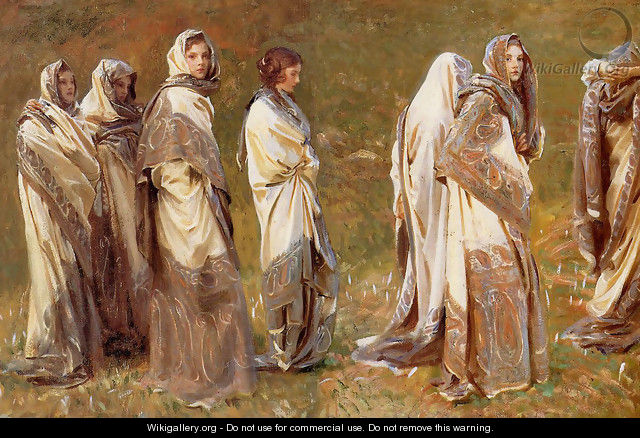
Third stop on the Cashmere train is brought to you by John Singer Sargent (1856 - 1925), the American painter renowned for exquisite portraiture and landscapes. While many of Sargent's works are breathtaking, my very favorite is a piece called Cashmere (1908). In it, Sargent presents seven poses of his niece, Reine, wrapped in a lovely shawl made of... you know. Sadly, I will never see this painting in person, unless Bill Gates invites me to his house. Because he owns it.

Some billionaires have all the luck.

Finally, I offer for your consideration the song "Kashmir" by Led Zeppelin. This song is wonderful in its own right, but it holds a special place in my heart. When I dated Mr. Boyce, we once became engrossed in a conversation with this song looping in the background. After hearing it ten times, we either had to declare ourselves totally over it or make it our song. It became our song, though we did not dance to it at our wedding. It doesn't really have a good beat for that. In retrospect, though, that would have been quite the memorable first dance. Opportunity lost. Oh, well. Maybe at our fiftieth anniversary party.


While you're rocking out to the above, tell me about your favorite homonyms! Or your favorite cashmere / Kashmir-related story. Or share a link to the cashmere item you covet most. Whichever.

Thursday, May 24, 2012

Speak No Evil, Or: Learning When To Shut Your Mouth

In this, the third and final installment of my just-because series revolving loosely--like Pluto--around the old adage, we turn our attention to the final bit of sage advice, Speak No Evil. While my thoughts are directed toward writing, I believe the following applies to any professional endeavor.

A.K.A. Shut Yo Mouth!


As a writer struggling to break into publishing, one of the traps that's easy to fall into (and of which I have been guilty on many an occasion) is bad talking agents and editors who reject a manuscript. It feels supportive to tell a friend, "That idiot doesn't know what they're talking about!" or "They'll be sorry they rejected you when you hit the NY Times bestseller list!"

But are such remarks really supportive? What about those statements offers comfort to our friends or ourselves? The fact is, those "idiot" agents and editors generally do know what they're talking about. Maybe you haven't actually written a heartbreaking piece of genius. Maybe that manuscript really isn't a good match for that particular agent or publishing house. Maybe, just maybe, those rejections come from a place of professional expertise.

Discretion really is the greater part of
valor. I'm not even kidding, you guys.
It's momentarily satisfying to shove blame for our hurt feelings onto someone else. But that's a passing rush, like the thrill of eating half a birthday cake in one sitting. It might be yummy, but those are empty calories and you'll regret it later [I think this metaphor actually just reveals I'm jonesing for birthday cake. Again. ANYWAY.] Behaving this way doesn't help us grow as writers, either in craft or professionalism. Learning to take rejection gracefully is part of the process.

Just like the occasional piece of birthday cake is fine and dandy (mmmm... cake), it's ok to engage in the occasional vent session when you get a disappointing rejection. What's not ok is ranting every time you're rejected. It's not ok to call everyone in the publishing world an idiot. If you do that, ask yourself why would you even want to become professionally involved with a bunch of idiots?

Also... why would the publishing industry want to involve itself with someone who calls them idiots? Dun, dun, duuuuuuun.

"But, Elizabeth!" you say. "I only ranted about Sally Agent on my writing board! She'll never know!" Oh, won't she? The truth is, anything you put on the Internet may come back around to nibble on your derriere.

WARNING: Cautionary Tale Ahead!

Once upon a time, dear readers, I was a young and foolish novice writer. I had some writing friends, and a great online community of writers I loved. One day, one of my buddies got some nasty commentary on their manuscript from a reader at Big Publishing House. I was shocked and appalled on their behalf. How could my friend be treated so cruelly?

"Hey, isn't that the guy who called you a jerk and said your
turban makes it look like you've always just left
that spa in Fresno?"
"Oh, yeah, it is! I hate this guy! Screw him."
Now, what would you do in that situation? If you're young, foolish me, you'd have run straight to your online writing board and reported the incident there, where you could rock everyone's world with news of Big Publishing House's treatment of your friend.

I bet you wouldn't expect the senior editor of Big Publishing House to post on your thread. I bet you didn't stop to think that someone, ANYONE, associated with Big Publishing House would see your remarks. After all, it's just you and a bunch of other struggling writers on this board, right? Wrong.

You don't know who's lurking on writing boards. You don't suspect that the very first impression you give the senior editor of Big Publishing House would be that you're the kind of person who spreads unfavorable gossip about their highly regarded company when a summer intern does something stupid like let their snide remarks about a manuscript get back to the writer. But that might be exactly what happens.

The moral of the story is to be smart. Think before you open your mouth or let your fingers fly. Don't post anything in a public forum you wouldn't want the object of your remarks to see. Don't say anything in a public venue you don't want passed around.

Believe it or not, the publishing industry is a pretty small world. Don't burn bridges before you've even had the chance to cross them. Keep it professional. Next time you or your friend is rejected, try to find a way to express your feelings without insulting the very people you hope someday to be working with.

Thursday, May 10, 2012

See No Evil, Or: Dressing Like a Lady in the Regency

Part two of my blog series loosely inspired by Hear No Evil, See No Evil, Speak No Evil will relate to ladies' fashion during the Regency. This post is a long time coming, as I touched on Regency menswear quite a while back.

I can't see that drab pelisse!
"See No Evil" is relevant to this topic, as dressing properly was a full-time occupation for the Regency lady. It was of utmost importance that she present herself as fashionable and attractive--after all, the young lady's job was to marry well. How better to present oneself as manbait than with the right attire?

This will be only the briefest bit of information, as a thorough survey of the topic of Regency fashion could (and has) fill a whole book.

The latter part of the eighteenth and the first twenty years of the nineteenth century were an anomaly of fashion, wedged as they were between eras of flamboyant, Gothic styles. Right around 1800, the crack of women's fashion would be best described as pure Classical. The vertical lines of garments were reminiscent of Greek statuary--indeed, white was a popular color as it hearkened to the marble used to depict ancient goddesses. Long lines conveyed pillars of strength, a sign of courage during this time of war and civil unrest. Hairstyles also emulated classic Greek design--curls piled atop the head, held back with bandeaus and turbans, with loose tendrils framing the face.

Miss Dashwood, I think your dress may have
slipped... just a bit... there.

Now, as we all know, the female form is a ghastly thing--particularly the hip region. You think not liking how your butt looks in those jeans is new? Heavens, no. Women have been utilizing textile trickery to conceal and distract the supposed bad parts of their figures for ages. Literally. Like, since the Bronze Age.

The Regency was no different. I'm sure you're all familiar with the typical Regency dress: High waisted, loose skirts that concealed the hips while revealing just about everything else. Materials were thin and clung to the body to emphasize the shapes of the breasts and legs (But not the hips. Gracious.).

Victoria's Secret catalog,
circa 1811.
A lady of the Regency era had it easy in the undergarment department, compared to her Victorian daughters and granddaughters. Drawers were initially menswear. By the early 1800's, women had started to borrow the idea for their own wardrobes, but they weren't in common use until later in the century. At the time of the Regency, many regarded wearing anything masculine as vulgar. Much better to do without anything down there but the breeze. Ahem. So a Regency lady may or may not don drawers. The next layer of clothing would be the chemise or shift (which functioned like a modern slip), topped with a set of short, soft stays and perhaps a single petticoat, depending on the dress she planned to wear. Undergarments were white, to convey the wearer's purity of heart and mind (and body, you naughty rake!).

Muslin was the fabric of choice for the masses. It was inexpensive, and had a marvelous way of displaying a woman's anatomy just so. It was widely used for undergarments and a whole array of dresses used from morning to night. The most daring, fast women might dampen their chemise so the muslin skirt of the dress would cling closely to the legs (and Catholic schoolgirls thought rolling their waistbands was innovative. Pfft.).

You know you want to wear that turban.
Even though the Regency lady was happy to show off her curves (except the hips--puke), do not think she had no standards of modesty. A proper lady always covered her head when she left the house, and took a covering like a shawl, pelisse, or spencer along. The bosom only came out to play at night, although day dresses still emphasized shape. Gloves were absolutely de rigeur, both inside and out. A lady took her gloves off to eat, then put them on again when the meal was over. Can't go about with our fingers dangling loose like a common hussy now, can we?

If the form of the Regency woman's dress was rather simple, they found a lot of room for fun in the color department. Especially when it came to evening wear, the brighter, the better! Jewel tones and primary colors were popular, and there's good reasoning behind this. The Regency ballroom or dining room was illuminated only by candlelight, with the occasional oil lamp tossed in for variety. The dim, yellow light washed out pale colors. Only the boldest shades stood up to contemporary luminary shortcomings. White was a popular choice for gowns, too, and was mandatory for a young lady's debut ball. Satins and silks reflected light nicely. Metal adornments like spangles sewed onto skirts and turbans, silver and gold thread worked into lace, and jewelry added sparkle to catch a gentleman's eye and show your rivals you mean business.

I hope you've enjoyed this very brief foray into Regency women's fashion! There is so much more to explore. Maybe we'll revisit the topic again in a future post.