Showing posts with label Travel. Show all posts

Monday, August 20, 2012

Regency Holiday: Lake District

We've all grown a little weary of sand in our bikini bottoms and bug spray landing in our mouths. The new school year is just around the corner. Summer is winding down, and so, too, is our tour of Regency travel destinations.

I have one last trip in store for you this year, and it's a great one. Rally yourself and grab your sunglasses and a canoe; we're going to the Lake District!

The Lake District is located in northwest England. It's a region of mountains (or 'fells') and valleys, strewn with several dozen bodies of water, with their attendant rivers, streams, and falls. This area is the wettest part of England, receiving about 80 inches of rain per year. Fog is also common around the hills. In fact, the sun only shines a few hours per day, on average. So, what made it a popular Regency destination? Take a peek:
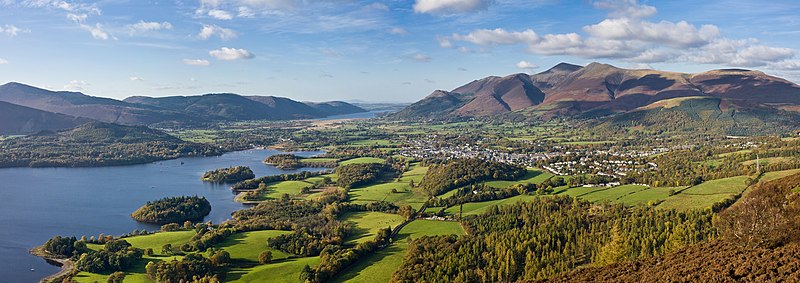
Picturesque as hell!

The Lake District wasn't as rustic as Scotland, but offered great fishing opportunities for the angler who couldn't venture north of the border. Hikes and rambles were popular. Getting out on the water in a rowboat or sailboat was a fine way to see some sights. During the Regency, there was also a great passion for sketching. Drawing was one of the accomplishments de rigeur for young ladies, so most women spent at least part of their Lake District vacation practicing their use of perspective. Sketching a favorite vista also provided a way to commemorate one's trip in a time before cameras. Poets and artists flocked to the Lake District to drink in the inspiring majesty of nature.

Seriously! So. Freaking. Quaint. I can't even stand it.
We must recall that in the late 18th and early 19th centuries, the Continent was aflame with war. Travel abroad was not only prohibitively expensive for many, it just wasn't safe, either. The Prince Regent -- that man of refined, sophisticated, worldly tastes -- never so much as crossed the English Channel (Though we've seen how he tried to bring a little bit of the outside world to his Royal Pavilion in Brighton.). His country was either penned in by, or involved in, war for most of his lifetime. It was quite out of the question for the heir to the British throne to risk his safety for a sightseeing tour of Paris.

The Prince and other wanderlust-afflicted Englishmen and -women therefore had to look within their own borders for travel destinations. 

Their rest stops might seem fancier than ours, but trust me,
skip the ladies' room and just head behind a tree.
In 1778, a Jesuit priest named Thomas West published A Guide to the Lakes, perhaps the first tourist guide ever produced. In his book, West describes the best viewpoints within the Lake District from which visitors could appreciate the landscape. Stations were built in several of these places to facilitate the aforementioned landscape appreciation. The Lake District of England was, then, one of the first locations deliberately cultivated for tourism. And Regency-era Englishfolk were the first generation to grow up with a love of hitting the road and seeing the sights within their own country, just for the pleasure of it.

I hope you've enjoyed this Regency Holiday series. I certainly had a great time learning more about these historical travel destinations to share with you. I didn't quite get to every stop I wanted to make, so hopefully we can take another jaunt next year. Enjoy the rest of your summer, Bluestockings!


Thursday, July 19, 2012

Regency Holiday: Scotland

Dear reader, summer is really starting to kick my tootkus. So much so that we're going to leave England behind altogether for this installment of my Regency travel guide and escape to cooler climes. If you're just joining us on our holiday excursions, we've already visited Bath and Brighton. Today we traverse the Great North Road to wild, beautiful Scotland.


If you don't recall your geography lessons, for shame. Your teacher put a lot of time and effort into trying to mold your mind. Your inattention is why she went home and drank wine and cried to her cat every night. Be that as it may, here's a quick reminder of Scotland's location:

Jamie Fraser resides in the Scottish Highlands. And in my heart.
It's the orange bit on the map. Scotland occupies the northern portion of Great Britain. At the time of the Regency, Edinburgh was the most cosmopolitan city in the country. It was far less populated than London, of course, but boasted a social scene on par with the ton's, but on a smaller scale. There was a season, theater, balls, parties, and all the normal diversions. So, an urbane aristocrat who wished to flee London's heat could summer in Edinburgh and carry on much as he ever did.


Scotland's greatest attraction to uncomfortably warm Englishfolk, however, was the countryside. A fair number of English lords owned estates in Scotland. An invitation to a house party on one of these Scottish estates was quite the hot commodity come summer. Guests descended on the host's home for a stay of a week or two, sometimes upwards of a month. During this time, the company engaged in civilized activities such as after-dinner charades, musical evenings, horseback riding, and stealing kisses in the hedge maze.


Others owned a property called a "hunting box," a quaint term which could refer to a house ranging in size from a cabin to a mansion only slightly less grand than the family heap. The hunting box's prime distinction was that it was a retreat for the sporting gentleman, rather than a family home. Here, a man might pass a couple weeks with his friends, partaking in such manly pursuits as hunting, fishing, and... well, it was pretty much hunting and fishing. Maybe they wrestled bears, too. I don't know.

The moor, aka Scotland's Nebraska.
Grouse, partridges, and pheasants were all brought down with fowling guns. A "grouse moor" was a prime piece of real estate for bird hunting. One person, called the "beater," walked in front of the hunting party swatting at the ground, trying to flush birds out. When they took to the air, ka-boom! Felled birds were fetched by dogs. It was all terribly manly, you see. So very, very manly.

Land-bound game, such as hare and deer, were also defeated by the Regency huntsman. Oh, and did I mention the "cub hunt"? This was a pastime in which inexperienced riders could practice hunting baby foxes. So. Very. Manly.

Perhaps more picturesque than the grouse moors were the fishing spots. Rivers, streams, and lochs provided cool water for swimming, foot dangling, and shoving unsuspecting buddies. Fly fishing was the method by which men later boasted about how they came thisclose to bringing in an absolutely enormous trout. No, really, you guys, you should've seen this thing. It darn near pulled my arm out of the socket.

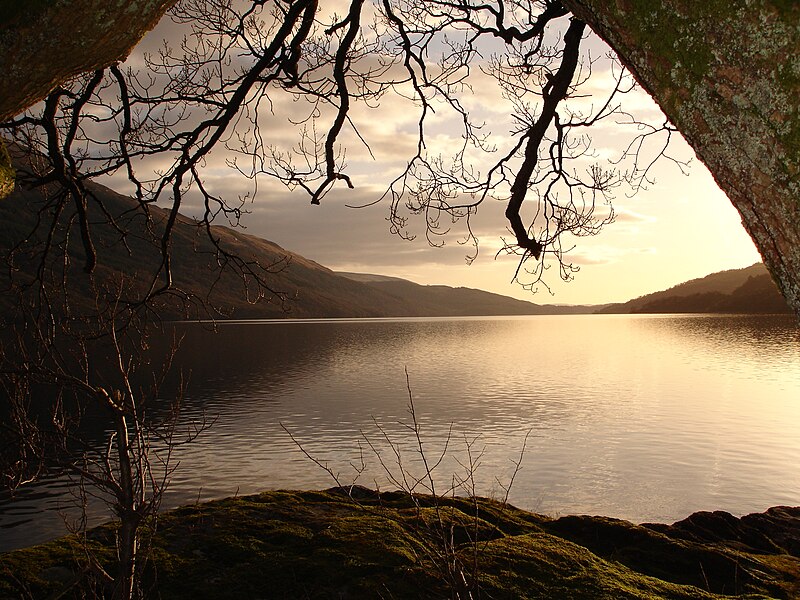
Loch Lomond, upon the bonnie, bonnie banks of which I shall never again meet my true love.
Whether it was a mixed-company house party, or a week with the boys at the hunting box, Scotland gave Regency travelers a much-needed break from the summer heat. Its natural beauty offered vacationers all the fresh air and exercise they wanted. Rusticating never felt so good.


Friday, July 6, 2012

Regency Holiday: Brighton

Summer marches on, and we we continue our tour of Regency holiday hot-spots in Brighton.

Located on the southern coast of Great Britain, Brighton began its days as a humble fishing village. This all changed when George, Prince of Wales (later to become Regent) came to call in 1783. Brighton became his favorite getaway, thanks to the relaxed atmosphere. Here, he and his friends could do as they pleased without the prince's rigidly moral parents looking over his shoulder. The Prince loved the town, and the town loved him right back. Under the Prince's patronage, Brighton grew and grew, quickly transforming from a podunk backwater to the nation's premier resort.

The Prince of Wales' Brighton residence underwent a metamorphosis even more spectacular than that of the town itself. The Marine Pavilion was a gracious Georgian mansion. Take a peek:

There is nothing wrong with this house.

By the time George became Regent, he'd been visiting Brighton for more than 25 years. He felt his abode was due a bit of pizzazz. To that end, the Prince Regent indulged his favorite pastime--begging money off Parliament--and did a little renovating.

Just a bit.

The exterior of the newly-styled Royal Pavilion was clearly informed by Eastern design. The interior was a Chinese fantasy land, replete with dragons, bamboo, lacquered cabinetry, Chinese wallpapers and lanterns, pagodas, and vivid colors. The Regent, who never traveled abroad, had a lifelong fascination with China. He imagined it to be a realm full of contented people, a dream of harmonious beauty and grace. In London, the Regent did constant battle with Parliament and his own ministers. He was ridiculed by a populace that found his passion for architecture, art, and music to be foolish. His marriage was a disaster of epic proportions. Even the weather was against him; the cold and damp aggravated his rheumatism and other complaints. The Royal Pavilion in Brighton was his escape. It--and by extension, the town--was a magical kingdom by the sea where the prince was free to indulge his every whim without fear of repercussion. In Brighton, George was respected and admired like he never was in London.

I have not forgotten all the other tourists, I promise. I wanted to give you some information about the Prince's involvement with Brighton, because he was the entire reason it became a tourist destination. When the Prince of Wales came to town, people followed. Initially, they were the Prince's entourage of friends--rich aristocrats, stylish ladies, and the trendsetters of the day--whom he lavishly entertained at the Pavilion. Eventually, visitors who were not part of the Prince's personal retinue came to Brighton to see what the fuss was all about.

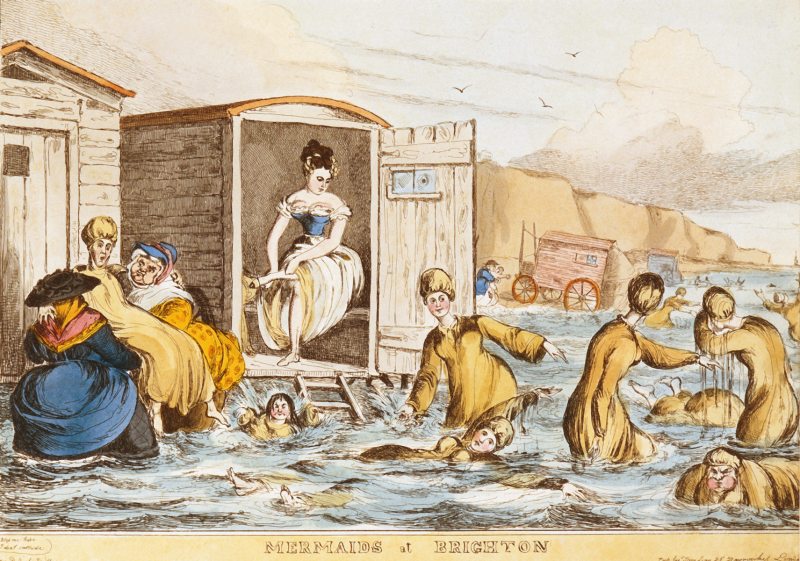
Sports Illustrated Swimsuit Issue, 1826
Summer in Brighton was a time of great seaside fun. Each year, a festival was held to mark the Regent's August 12 birthday. The whole town was invited to the party. There were mock naval battles and military reviews. A ball was held at Castle Inn, while roasted ox and ale were served to all.

The town boasted entertainments to suit every taste, high and low. Sea bathing was popular, as were the vapor baths (saunas). Plays and concerts provided theatrical amusement, while sport fans could take part in horse racing, bull baiting, and cockfighting. Middle class tourists who would never see the inside of the place enjoyed gawking at the opulent Royal Pavilion.

For the upper crust, the Steine was to Brighton what Hyde Park was to London. It was a green area first used by fishermen as a place to dry their nets. When the ton came to town, working folk were shoved aside and the Steine became the site of the afternoon fashionable hour, the place to stroll and mingle, to see and be seen. High-end merchants followed their wealthy clientele to Brighton and set up temporary shops which closed again when the moneyed horde left. After rounds of calls and shopping, the usual society balls and card parties filled evenings not spent at the Pavilion with the Regent.

Brighton was also notable for its tourist real estate properties. Houses were built special for the purpose of renting them to visitors for brief durations of time. New houses erected along the Steine were let for a week or two at a time. In this way, Brighton was truly innovative in encouraging tourism, making the town easily accessible to those early vacationers.

In the two centuries since the Regency, Brighton has continued on the path set by the Prince. It remains a popular tourist destination, hosting arts and music festivals, museums, and the ever popular beach fun. Brighton's nightlife has retained the freewheeling edge favored by the Prince Regent. The much-maligned Royal Pavilion still stands, and has become Brighton's most celebrated landmark. It is now open to the public and houses a museum to the Regency.

Next stop: the Taj Ma--no, wait, still Brighton.